Claude Fable 5: Anthropic's Mythos Class Goes Public, With Caveats
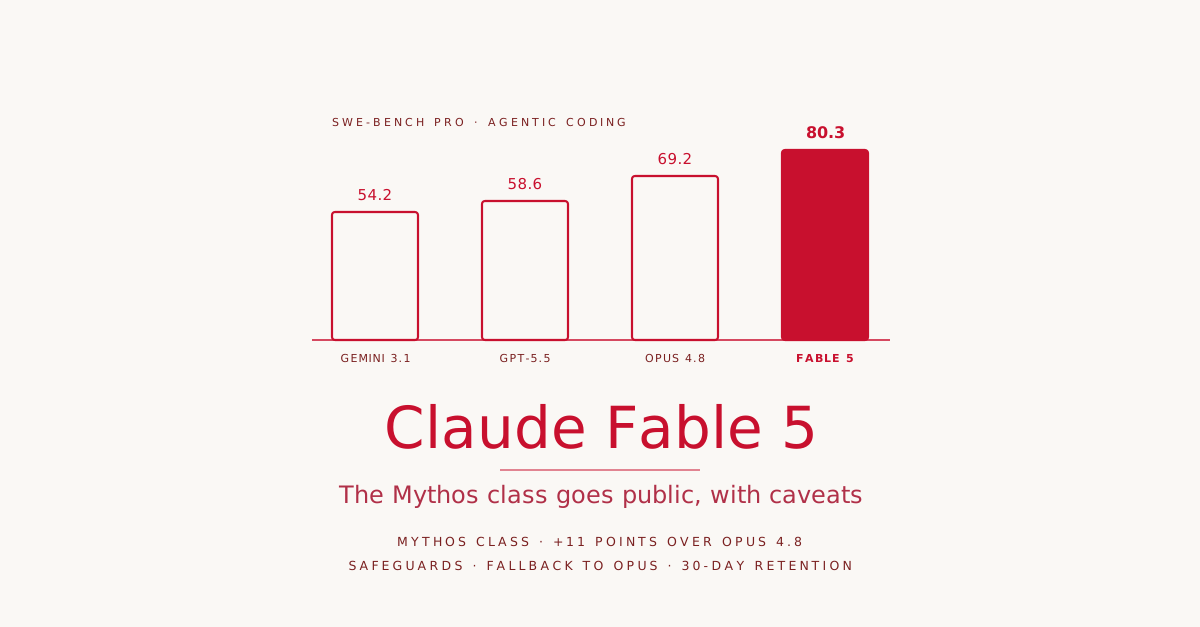
In April 2026, Anthropic introduced Claude Mythos Preview and explicitly did not release it for general use. The reasoning was that the capabilities were too delicate. Two months later, on June 9, 2026, the Mythos class is publicly available, as Claude Fable 5. TechCrunch sums up the punchline dryly: Anthropic releases its most powerful model “days after warning AI is getting too dangerous”. The critical line from my April piece on Mythos can be continued from here.
From Mythos Preview to Fable 5
Anthropic releases two models on the same base. Claude Fable 5 is the publicly accessible variant, safeguarded for general use. Claude Mythos 5 is the same model with the protections lifted in certain areas, accessible only to approved organizations in cybersecurity and life sciences. The digitalapplied analysis aptly calls it “the frontier, split in two”.
The difference lies solely in the safeguards. Fable 5 includes a fallback mechanism: requests in high-risk areas such as cybersecurity and biology are not answered by the model directly, but passed to Claude Opus 4.8. According to Anthropic, this fallback triggers on average in fewer than five percent of sessions (Anthropic, via IT Pro, June 2026). Mythos 5 exposes more of the model for its approved users.
That closes the loop with the April episode. The model held back in spring is now released by hiding the delicate capabilities behind a redirect mechanism and reserving unfiltered access for a closed circle. The Mythos class thus reaches the public, but in a form that does not resolve the original risk argument so much as administer it.
The Benchmarks
On the raw numbers, Fable 5 is undisputedly ahead. The following figures come from Anthropic and were picked up by several outlets (VentureBeat, the-decoder, Vellum, June 2026). The evidence here is vendor benchmarks, not independent measurements.
| Benchmark | Fable 5 / Mythos 5 | Opus 4.8 | GPT-5.5 | Gemini 3.1 Pro |
|---|---|---|---|---|
| SWE-bench Pro | 80.3% | 69.2% | 58.6% | 54.2% |
| FrontierCode Diamond | 29.3% | 13.4% | 5.7% | — |
| Terminal-Bench 2.1 | 88.0% | — | — | — |
The gap on SWE-bench Pro is the headline: a good twenty points ahead of GPT-5.5 and eleven ahead of Anthropic’s own Opus 4.8. FrontierCode Diamond is more interesting than the SWE number. The benchmark comes from Cognition, the makers of Devin, and tests not whether code runs somehow, but whether a maintainer would actually merge the code the model produces. That the absolute values there are low, 29.3 percent for Fable 5, shows how far even the best model is from reliably mergeable work. The relative gap to GPT-5.5 at 5.7 percent is still substantial.
Two demos belong to the context of the capability claims. Anthropic had Stripe run a migration across a 50 million line Ruby codebase, reportedly in a single day. And the model allegedly beats Pokémon Fire Red with a vision-only harness, without the additional tools earlier models needed for it. Both are Anthropic’s own figures, not independently reproduced results.
The Safeguards and Their Cost
The fallback mechanism is the actual product decision behind Fable 5, and it has a cost. When Fable 5 classifies a request as delicate, the answer comes not from Fable 5 but from Opus 4.8. For the user that means: you pay the top price but, in the gray zone, get the weaker model’s answer, or none at all.
The threshold is likely low. Anyone who has dealt with Opus safeguards knows the pattern of false positives. In Fable 5, a classifier detects requests related to cybersecurity, biology, chemistry, or model distillation and automatically routes them to Opus 4.8 (Anthropic, via SecurityWeek, June 2026). One external testing partner described Fable 5’s cyber safeguards as the most robust of any model tested, Opus 4.8 and 4.7 included. From a safety standpoint, that is the intended effect. From a user standpoint, it means an entire domain is effectively outsourced to the weaker model, unless you belong to the approved Mythos 5 organizations.
This extends the epistemic core of the April debate. Who gets access to the full capabilities and who does not is decided by Anthropic. The split into Fable 5 and Mythos 5 institutionalizes exactly the trust-based rather than rule-based risk assessment already criticized with Project Glasswing.
The Pricing and Plan Maneuver
On price, it gets uncomfortable. Fable 5 costs 10 US dollars per million input tokens and 50 US dollars per million output tokens (Anthropic, June 2026). That is about double Opus 4.8, but less than half of what Mythos Preview would have cost. For a frontier model, that is no outlier on the high side.
The actual maneuver is in the plan availability. From release day through June 22, Fable 5 is included at no extra cost in the Pro, Max, Team, and seat-based Enterprise plans. On June 23, Anthropic removes the model from those plans, after which usage requires credits. At some later, unstated point it is supposed to return to the plans (Anthropic, via VentureBeat, June 2026).
The choreography is transparent. You get two weeks of unlimited appetite for the best model, then it is pulled away and costs extra. It is a mechanism that creates habituation and then monetizes it. At the same time it signals how expensive running these models must be for Anthropic itself. Fitting with that, Fable 5 burns through the usage limit roughly twice as fast as Opus, a direct consequence of the doubled token price, which makes it unattractive as a permanent main model for most.
The timing deserves its own footnote. Several outlets place the release just days before a possible record IPO for Anthropic (The Next Web, June 2026). A capability record shortly before the IPO is not inherently suspicious, but it belongs in the assessment.
The 30-Day Data Retention
A detail that gets lost under the capability headlines concerns the data. Anyone using Fable 5 or Mythos 5 has to agree to 30-day retention of all traffic, across both Anthropic’s own surfaces and third parties like Amazon Bedrock or GitHub Copilot. The rule applies, per Anthropic, to future models of similar or higher capability as well.
Anthropic assures that it will not use this data to train new models or for purposes outside of safety, that it logs human access, and that it deletes the data after 30 days in almost all cases (Anthropic, June 2026). The justification is abuse prevention. The tradeoff is real nonetheless: for the capabilities of the Mythos class, you give up a piece of confidentiality that weaker models do not require. Anyone working with sensitive codebases or data should weigh that before switching.
Conclusion
Claude Fable 5 is technically what the benchmarks claim, a clear leap in agentic coding and long-running tasks. The figures are vendor benchmarks and carry the usual caveat, but the gap is large enough to be real.
More interesting than the numbers is the packaging. Anthropic does not resolve the tension of the April episode so much as turn it into a product. The too-dangerous model is released by redirecting the danger into a fallback and reserving unfiltered access for a closed circle. The pricing and plan choreography creates habituation and cashes it in. The data retention shifts a boundary that used to be taken for granted.
None of this makes Fable 5 a bad model. But it confirms the pattern that already defined Mythos Preview: at Anthropic, capability and staging are barely separable anymore, and the more impressive the demo, the more closely the fine print is worth reading. For everyday work, Opus 4.8 remains the more sensible choice for most, and Fable 5 the tool you reach for deliberately when a task genuinely demands it.