Claude Opus 5.5 in the Test Lab: Half the Cost, Because It Thinks Less
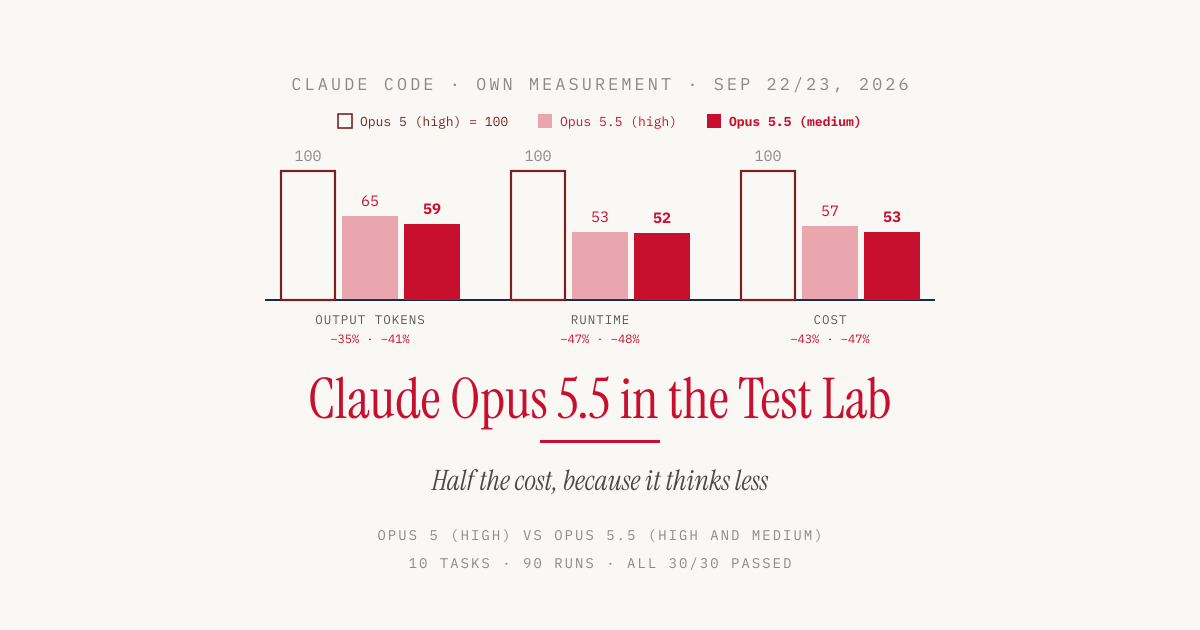
On September 22, 2026, Anthropic released Claude Opus 5.5. The promise is that Opus 5.5 works at the level of Fable 5.1 and costs about 40 percent less than Opus 5 on typical workloads. Only half of that comes from the price tag. The rest is supposed to come from the model needing fewer tokens for the same work. That can be measured, and on the same day.
The price drops by a fifth
The list prices are the easy half of the math. The table shows Anthropic’s list prices in euros per million tokens. Anthropic states its prices in US dollars and also bills in dollars. All euro amounts in this article are converted at the ECB reference rate of September 22, 2026 (€1 = $1.1463, dpa-AFX).
| Opus 5.5 | Opus 5 | Difference | |
|---|---|---|---|
| Input | 3.49 | 4.36 | −20% |
| Output | 17.45 | 21.81 | −20% |
| Cache read | 0.17 | 0.44 | −60% |
| Cache write (5 min) | 4.36 | 5.45 | −20% |
| Batch (input/output) | 1.74 / 8.72 | 2.18 / 10.90 | −20% |
| Fast mode (input/output) | 6.98 / 34.89 | 8.72 / 43.62 | −20% |
The cache read stands out. It drops by 60 percent and now costs only a twentieth of the regular input price. For long agentic sessions, where the same context is read again at every step, this is likely to matter more than the rest of the price cut. According to Anthropic, the context window stays at one million tokens, maximum output at 128,000 tokens, and the tokenizer is the same as in Opus 5. Token counts of both models can therefore be compared directly.
The model has to deliver the rest of the promised savings itself. To get from 80 to 60 percent of the previous cost, it needs roughly a quarter fewer tokens per task.
Anthropic’s benchmarks, measured at the top level
The numbers below are vendor figures, mostly measured at effort max or xhigh, meaning maximum reasoning depth.
| Benchmark | Opus 5.5 | Fable 5.1 | Opus 5 |
|---|---|---|---|
| Terminal-Bench 4.0 | 66.4% | 55.8% | 52.3% |
| FrontierCode v1.1 | 54.4% | 50.3% | 48.0% |
| CursorBench 4.0 | 57.8% | 51.8% | 46.6% |
| GDPval-AA v2.1 (Elo) | 1846 | 1735 | 1708 |
| Humanity’s Last Exam (with tools) | 67.7% | 65.6% | 63.6% |
| OSWorld 2.0 | 81.8% | 80.7% | 74.0% |
That puts Opus 5.5 ahead of Fable 5.1 everywhere, a model that costs two and a half times as much at €8.72 and €43.62 per million input and output tokens (Anthropic pricing). According to a footnote, Anthropic measured Terminal-Bench 4.0 with active safety classifiers. Where they intervened, Opus 4.8 or Opus 5 took over the task. Some of the points therefore do not come from Opus 5.5.
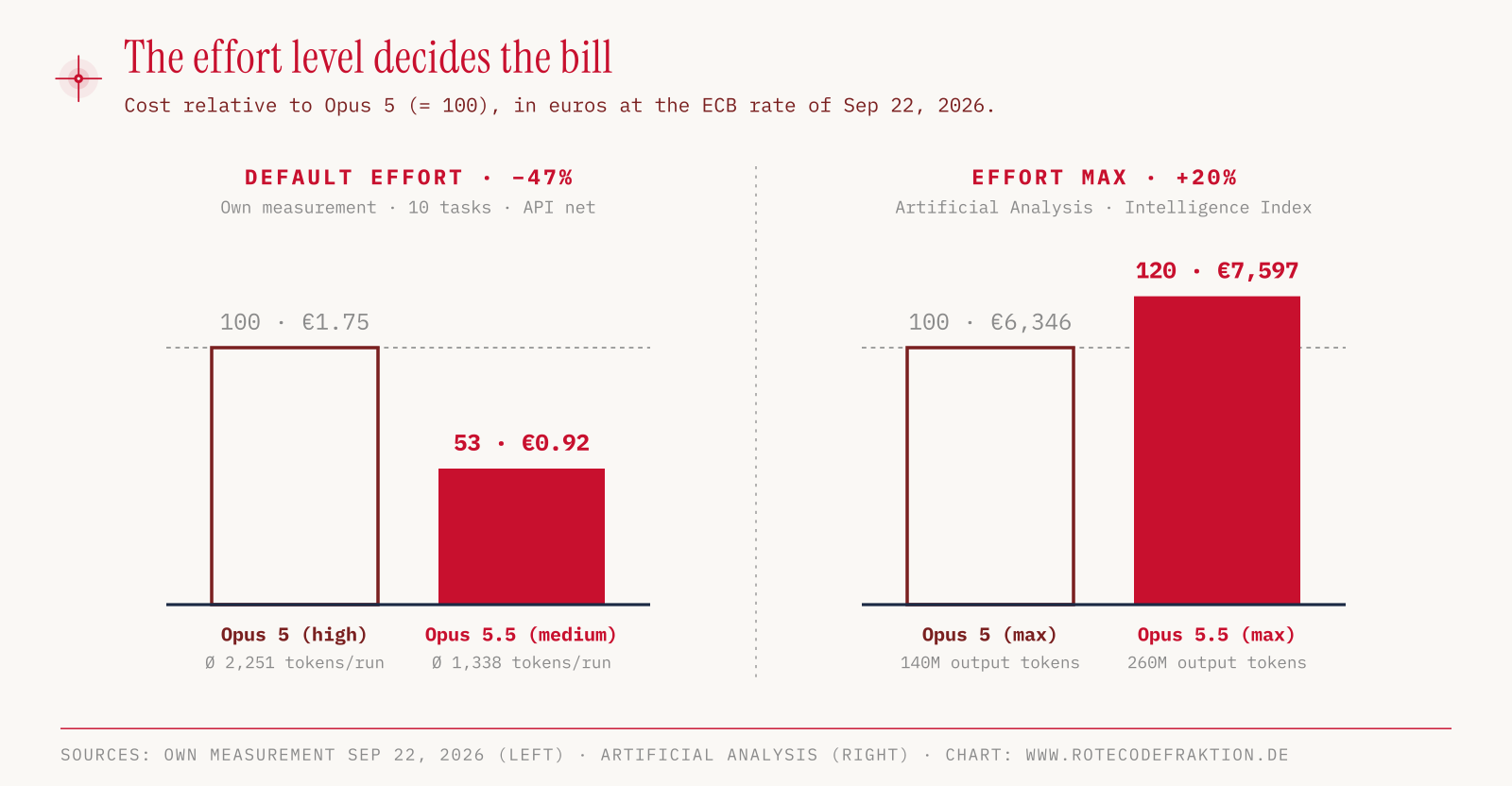
The first independent measurement comes from Artificial Analysis. There, Opus 5.5 at effort max leads the Intelligence Index with 58 points, while Opus 5 reaches 51 at the same level. For the index, Opus 5.5 generated 260 million output tokens, Opus 5 only 140 million. The run cost the equivalent of €7,597 compared with €6,346 for Opus 5. At the top level, the new model is thus about 20 percent more expensive than its predecessor despite lower prices.
The question for everyday use is therefore what happens at the default setting.
The default has shifted
On Opus 5.5, thinking can no longer be switched off. The only control is the effort level (low, medium, high, xhigh, max), which sets how much the model reasons before answering. The default level has also dropped. Without an explicit setting, Opus 5 runs at high, Opus 5.5 at medium.
In its migration guide, Anthropic justifies this by saying that Opus 5.5 at medium scores better on coding and knowledge-work evaluations than Opus 5 at high. At the same time, Opus 5.5 reportedly thinks longer than Opus 5 at the same level, especially at xhigh and max. If so, identical level names would not mean identical costs.
Anyone who calls a model without an effort setting gets its default. So I pit Opus 5.5 at medium against Opus 5 at high. To separate what comes from the model and what comes from the level, Opus 5.5 also runs at high.
The test setup
I did not want to rebuild a synthetic benchmark. I wanted tasks of the kind that come up in everyday work, with a result a machine can clearly judge as right or wrong. I ended up with ten tasks, five programming tasks (C), four data tasks (R), and one chart-reading task (V).
| Task | Content | Check |
|---|---|---|
| C1 | parse ISO 8601 durations, including 17 invalid inputs | asserts |
| C2 | unrestricted Damerau-Levenshtein distance | 307 cases against reference |
| C3 | public holidays in North Rhine-Westphalia with a self-computed Easter Sunday | 13 years against reference |
| C4 | arithmetic parser without eval, following Python’s precedence rules | 23 expressions |
| C5 | fix a buggy LRU cache | behavior tests |
| R1 | revenue growth per region from 72 CSV rows | exact value |
| R2 | recurring meeting on the last Thursday of each month in 2027, shifting for holidays | twelve dates |
| R3 | error rate and latencies from an access log | exact values |
| R4 | sessions from an event log using a 30-minute rule | exact values |
| V1 | read a bar chart without numbers (PNG) | exact values |
The C tasks produce code that runs against tests in a separate process. The R tasks return a JSON answer whose expected value the script computes itself from the same data.
C2 explicitly asks for the unrestricted variant of the Damerau-Levenshtein distance, which differs from the common “Optimal String Alignment” variant ("CA" to "ABC" yields 2 instead of 3). R2 contains exactly one date that falls on Corpus Christi. V1 checks Anthropic’s claim that Opus 5.5 reads charts much more accurately than Opus 5. The chart is an unlabeled PNG that the test run generates in Python.
Each task runs three times per configuration, 90 calls in total. Measurements go through Claude Code in headless mode:
claude -p "<task>" \
  --model claude-opus-5-5 --effort medium \
  --output-format json \
  --safe-mode --strict-mcp-config --tools "" \
  --no-session-persistence \
  --system-prompt "Du löst die gestellte Aufgabe selbstständig und vollständig."
Going through claude -p has a practical reason. It runs on a Claude subscription instead of API credit, so the whole test cost me nothing extra. The JSON output still contains all token counts, the time to first token, and the amount the same call would have cost at API list prices.
--safe-mode disables custom configuration, hooks, and plugins, --tools "" disables all tools. Only V1 gets the read tool for the image file. What remains is an overhead of about 700 tokens that Claude Code sends on its own. It is the same for all configurations and tends to push the percentage differences down slightly.
The complete code, including raw data, is in the claude-modellvergleich repository on Codeberg. Anyone with a Pro or Max subscription can repeat the measurement without an API key. For future models, the test can generate fresh task data from a new seed so that no model knows the solutions from its training data. The prompts themselves are in German.
I report two cost figures. “Claude Code” is the amount from the CLI, including the cache writes that Claude Code creates on every call. “API net” bills all tokens as if the same request went straight to the API without caching. The second figure is closer to what your own application would pay.
Same pass rate, half the bill
All three configurations passed all 30 runs. The differences lie entirely in tokens, time, and cost (own measurement, September 22, 2026, Opus 5.5 at high the following morning). Percentages are relative to Opus 5.
Opus 5 (high) | Opus 5.5 (high) | Opus 5.5 (medium) | |
|---|---|---|---|
| Passed | 30 / 30 | 30 / 30 | 30 / 30 |
| Output tokens per run (avg.) | 2,251 | 1,467 (−35%) | 1,338 (−41%) |
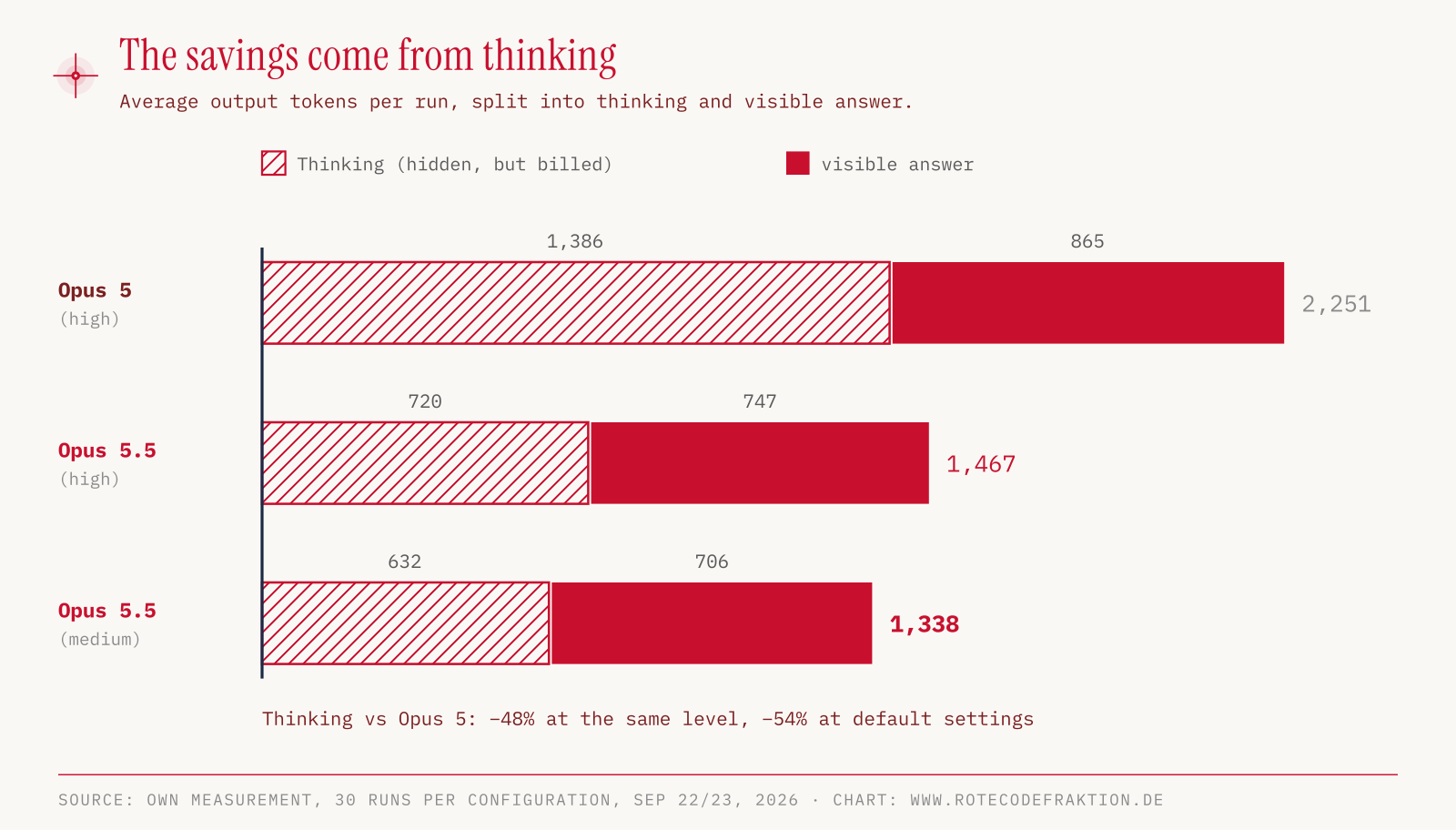
| of which thinking (avg.) | 1,386 | 720 (−48%) | 632 (−54%) |
| Duration (median) | 21.4 s | 11.4 s (−47%) | 11.1 s (−48%) |
| Time to first token (median) | 14.2 s | 5.9 s (−58%) | 5.5 s (−61%) |
| Cost Claude Code (30 runs) | €1.96 | €1.16 (−41%) | €1.09 (−44%) |
| Cost API net (30 runs) | €1.75 | €0.99 (−43%) | €0.92 (−47%) |
| API net per solved task | 5.8 ct | 3.3 ct | 3.1 ct |
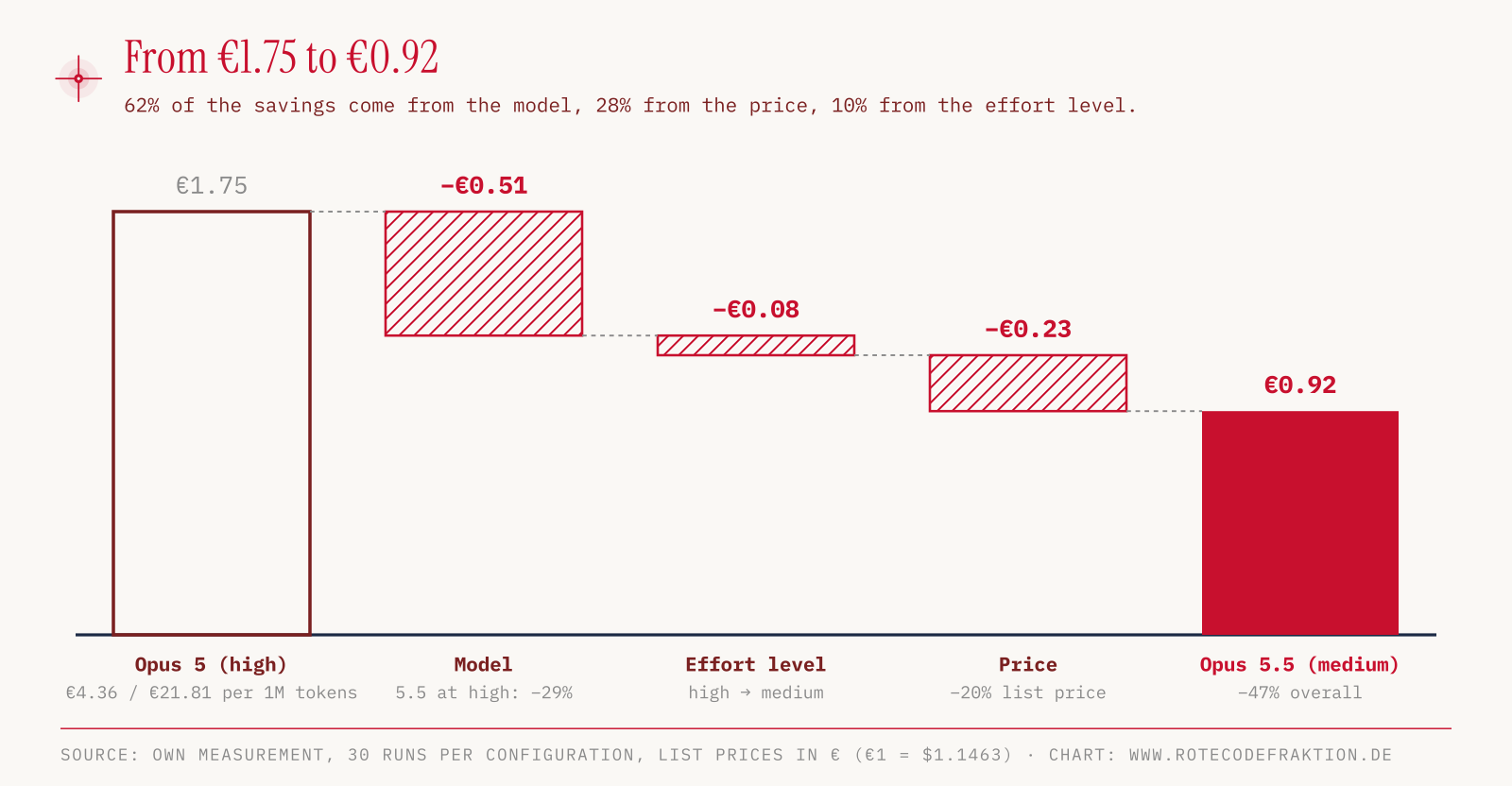
Comparing the default settings gives 47 percent lower cost. The additional configuration shows where it comes from. At Opus 5 prices, Opus 5.5 at high would have cost €1.24, 29 percent less than Opus 5 at the same level. That is the model’s share. The step down to medium saves another €0.08, the 20 percent lower list price €0.23. Of the €0.83 saved, 62 percent comes from the model, 28 percent from the price, and 10 percent from the lower default level. On these tasks, Anthropic’s “40 percent less” is, if anything, conservative.
A good four fifths of the saved tokens are thinking tokens. Opus 5 spends 62 percent of its output tokens on reasoning, Opus 5.5 at medium only 47 percent. Even at the same level, Opus 5.5 thinks about half as long as Opus 5, with 720 tokens against 1,386. Anthropic’s statement that Opus 5.5 thinks longer at the same level does not hold for these tasks. For xhigh and max, which Anthropic mainly refers to, it matches the Artificial Analysis numbers. The visible answer from Opus 5.5 is just under a fifth shorter. That also explains the wait. Until the first token of the answer arrives, the median is 14.2 seconds for Opus 5 and 5.5 seconds for Opus 5.5. In practice, this is what you notice first.
I could not confirm one of Anthropic’s claims. According to the release post, Opus 5.5 generates its output more than 30 percent faster than Opus 5. In my runs, throughput was between 250 and 280 tokens per second for all three configurations (output tokens divided by the time after the first token, median of individual runs, 278 for Opus 5, 247 and 266 for Opus 5.5 at high and medium). The halved runtime does not come from faster generation but from fewer tokens. The measurement is rough, though, because it includes the hidden thinking and was taken on launch day and the morning after, when the servers were probably under heavy load.
The savings vary by task
Per task (average of three runs, output tokens and duration; the last column compares the two default settings):
| Task | Opus 5 (high) | Opus 5.5 (high) | Opus 5.5 (medium) | less output |
|---|---|---|---|---|
| C1 ISO duration | 1,259 tok, 14 s | 916 tok, 8 s | 676 tok, 6 s | −46% |
| C2 Damerau-Levenshtein | 2,130 tok, 20 s | 1,037 tok, 8 s | 965 tok, 8 s | −55% |
| C3 holidays | 2,996 tok, 31 s | 2,136 tok, 18 s | 1,789 tok, 14 s | −40% |
| C4 parser | 1,928 tok, 20 s | 1,655 tok, 13 s | 1,524 tok, 12 s | −21% |
| C5 LRU fix | 1,010 tok, 11 s | 729 tok, 7 s | 617 tok, 6 s | −39% |
| R1 revenue | 3,369 tok, 29 s | 2,332 tok, 18 s | 2,177 tok, 16 s | −35% |
| R2 calendar | 3,181 tok, 32 s | 1,400 tok, 11 s | 1,299 tok, 10 s | −59% |
| R3 log | 2,184 tok, 20 s | 1,501 tok, 11 s | 1,299 tok, 11 s | −41% |
| R4 sessions | 2,820 tok, 25 s | 1,788 tok, 13 s | 1,845 tok, 13 s | −35% |
| V1 chart | 1,630 tok, 19 s | 1,174 tok, 11 s | 1,192 tok, 11 s | −27% |
The range runs from 21 percent for the parser to 59 percent for the calendar. The calendar task shows the largest gap, with Opus 5.5 reaching the same result with 59 percent less output. For the parser, the code itself makes up most of the answer, so there is less to save. Not a single one of the 30 Opus 5.5 runs at medium was more expensive than the cheapest Opus 5 run on the same task.
Both models read the V1 chart correctly in every run. The simple bar chart therefore shows no difference in reading accuracy. Opus 5.5 needed a good quarter fewer tokens, but that is below its average savings.
During evaluation, one Opus 5 run initially showed up as a failure. The parser code passed all tests but was rejected as disallowed. The cause was my checker. The block list against compile( had also caught a harmless re.compile(. After the fix, all configurations passed 30 of 30 runs. The evaluation script therefore re-grades all stored answers on every run, so that such fixes take effect without new model calls.
medium is enough for routine work
Stepping from high down to medium saves little on Opus 5.5, but it costs no quality either. Both levels passed all 30 runs. medium needs 9 percent fewer output tokens and 12 percent less thinking, it is 7 percent cheaper, and runtime differs by three tenths of a second. On R4 and V1, medium even came in slightly above high, so the gap between the levels is within the noise there.
The effort level sets how long the model deliberates before answering. On tasks with a clear solution path, such as writing a parser, aggregating data, or implementing a known algorithm, longer deliberation apparently finds nothing the shorter version misses. That is my inference from the numbers; what is measured is only that high brings no advantage here. Anthropic recommends the same approach in its migration guide: start with medium and use xhigh or max only where a quality gain has been measured.
This test does not show where higher levels pay off. According to Anthropic, that means long agentic coding tasks across large codebases and hard problems where even the default level fails. For everyday work, which consists of many small tasks like these, medium is the right default according to these numbers. If a specific task needs more, raise the level for that task.
Tasks too easy, no agent runs
The tasks were too easy for both models to measure quality differences. At 100 percent on both sides, there is no gap. The test therefore only answers what the same correct answer costs, not which model gets further on hard tasks. That would require tasks where Opus 5 fails.
On top of that, these are single calls, not agentic runs over many steps, where Anthropic says the largest gains lie and where the cheaper cache read really comes into play. Three repetitions per task is not much, even though the variance was small. And the measurement was taken on launch day and the morning after.
Four changes to the API
Anyone using Opus 5.5 through the API will find the changes in Anthropic’s migration guide.
- Thinking stays on.
thinking: {type: "disabled"}returns a 400 error at every effort level. Anyone who switched off thinking on Opus 5 for fast answers should move toeffort: "low". - The default is
medium. Code that does not set an effort level runs one level lower on Opus 5.5 than on Opus 5. According to my numbers, that is no disadvantage, but the level belongs explicitly in the request. - Forced tool calls are gone.
tool_choicewithanyor a fixed tool returns a 400 error. The replacement isautowith a clear instruction in the prompt andstrict: trueon the tool. - Thinking blocks are tied to the model and the conversation. For accounts created on or after August 31, 2026, the API checks whether the previous conversation history is unchanged. Anyone who edits the history afterwards, for example when summarizing old messages, gets an error.
According to the release post, Anthropic has raised usage limits for Pro, Max, and Team subscribers. In Claude Code, /model switches to the new model.
Conclusion
Anthropic’s math works out in my test, even slightly better than promised. At its default setting, Opus 5.5 solves the same tasks as Opus 5 at its default, with 41 percent less output, in half the time, and for 47 percent less money. Almost two thirds of the savings come from the model itself, which already thinks about half as long at the same level without getting things wrong. The price cut contributes a good quarter, the lower default level the rest.
The caveat comes from Artificial Analysis. At max, Opus 5.5 produces almost twice as many tokens as Opus 5 and ends up costing more than its predecessor. At medium and high, the model thinks more sparingly than its predecessor, at the highest level more lavishly. Anyone who sets Opus 5.5 to max out of habit pays more than before.
The cheapest token is the one that never gets thought.
Sources
- Anthropic, release post “Introducing Claude Opus 5.5” (prices, benchmarks, vendor figures): anthropic.com/claude-opus-5-5
- Anthropic, migration guide (default effort, API changes): platform.claude.com/docs/en/about-claude/models/migration-guide
- ECB reference rate of September 22, 2026 (€1 = $1.1463), dpa-AFX via finanzen.at: finanzen.at
- Anthropic, pricing (Fable 5.1): platform.claude.com/docs/en/about-claude/pricing
- Artificial Analysis, Opus 5.5 at
max(Intelligence Index, tokens, cost): artificialanalysis.ai/models/claude-opus-5-5 - Artificial Analysis, Opus 5 at
maxfor comparison: artificialanalysis.ai/models/claude-opus-5 - Own measurement: 90 runs via Claude Code 2.1.280, September 22 and 23, 2026, code and raw data: codeberg.org/rotecodefraktion/claude-modellvergleich