Majorana 2: Microsoft's Quantum Bet on an Unproven Particle
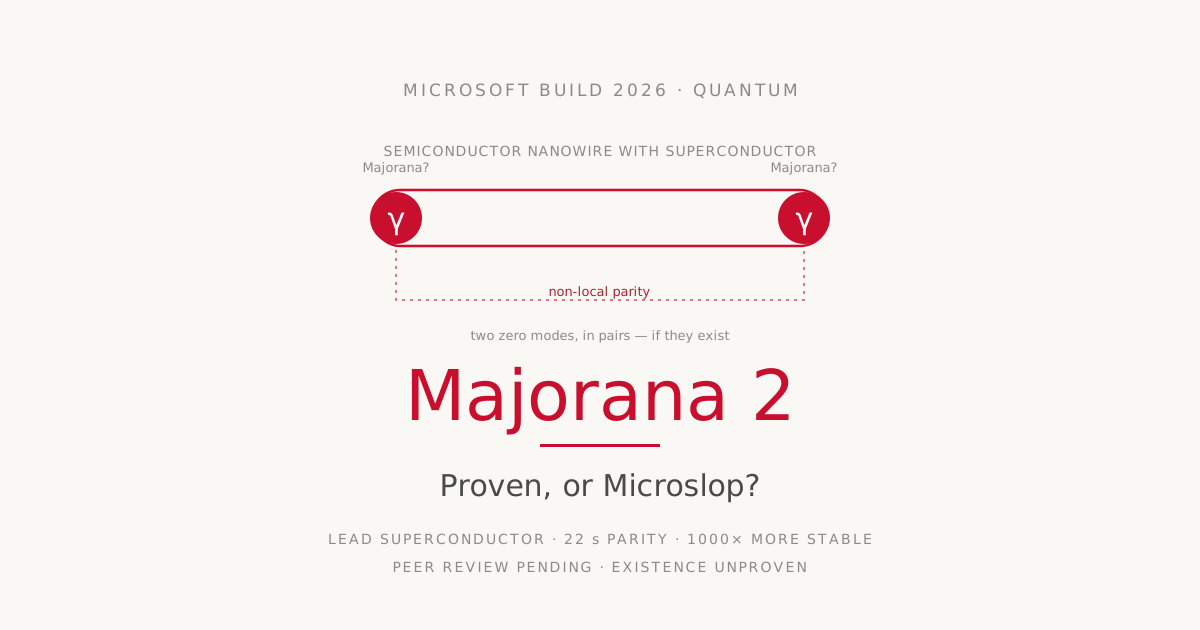
On June 2, 2026, Microsoft presented „Majorana 2" at its Build conference, a quantum chip the company says is 1,000 times more reliable than its predecessor and therefore clears „critical hurdles".1 The mean lifetime of the compute units is said to be 20 seconds, in some cases more than a minute. For quantum computers, that is an eternity.
The catch lies in the foundation. The chip relies on what are called Majorana quasiparticles. And in the field it is disputed to this day whether these particles are present in Microsoft’s devices at all.2 This is not an academic quibble. It is the question of whether the whole technology rests on a demonstrated effect or on a hope.
A Particle as a Thought Experiment
The particle takes its name from Ettore Majorana, an Italian physicist from the circle around Enrico Fermi. Fermi thought so highly of his young colleague’s talent that he mentioned him in the same breath as Galileo and Newton. In 1937 Majorana described a hypothetical particle with an unusual property: it is its own antiparticle. A year later he vanished without trace on a ship passage between Palermo and Naples, and the case has never been resolved.3
The particle remained. Majorana showed that its existence is compatible with the laws of quantum physics. Whether it exists as a fundamental particle is open to this day. Candidates are discussed in particle physics, for instance the neutrino, but nothing is proven.
For quantum computers it is not the fundamental particle that matters, though, but a descendant of it: the Majorana quasiparticle.
From Particle to Quasiparticle
A quasiparticle is not a building block of matter but a collective excitation in a solid that behaves as if it were a particle. Waves in a sea of electrons that bundle up and move like a self-contained object.
In certain materials, excitations are supposed to arise that carry exactly the peculiarities of Majorana particles. They are called Majorana zero modes. In theory they appear at the ends of a topological superconductor, for example a semiconductor nanowire with strong spin-orbit coupling, coupled to a superconductor and placed in a magnetic field.4 They always occur in pairs, one at each wire end.
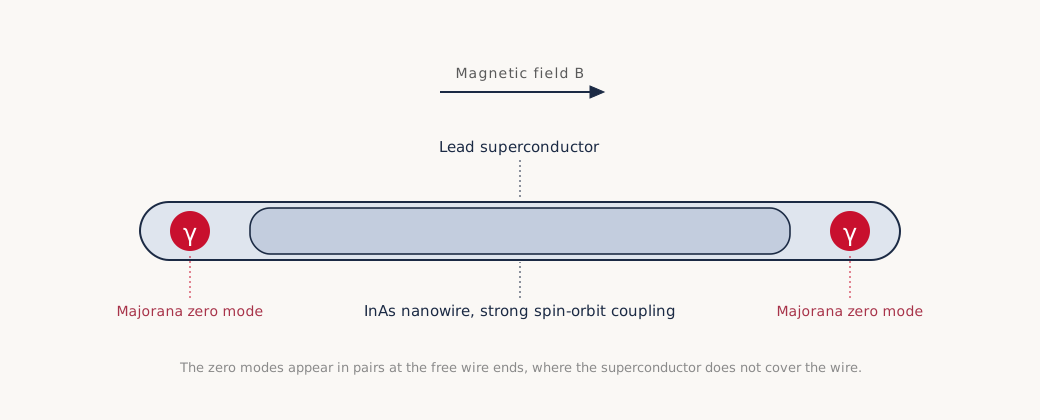
This pairing is the decisive point. It is not just a detail, it is the whole trick.
Intrinsic Stability as a Promise
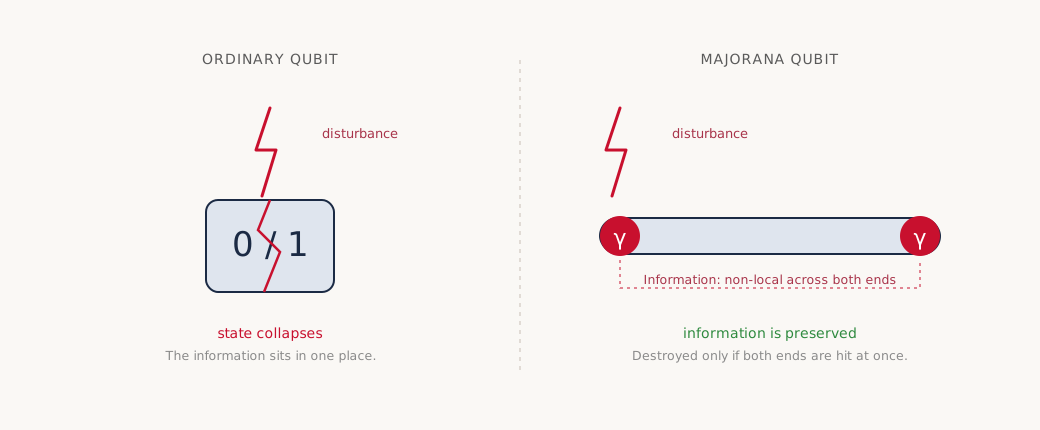
The compute units of a quantum computer, the qubits, are notoriously unstable. Unlike a classical bit, which is unambiguously 0 or 1, a qubit holds a superposition of both states. This superposition is extremely sensitive. Any small disturbance from the environment, a vibration, a stray field, a thermal quantum, throws the qubit off and the computation collapses. This is called decoherence. That is why qubits run near absolute zero, shielded, and still often hold their state only for fractions of a second.
Majorana qubits promise a way out, and a fundamental one. The information is not stored in one place but non-locally, spread across the pair of two spatially separated Majorana zero modes. Concretely it sits in a joint quantity of the two, the so-called parity.4 A local disturbance at one wire end can neither read out nor destroy this distributed information, as long as it does not hit both ends at once. This is called topological protection.
The picture for it: a secret number, split across two safes at opposite ends of a room. Whoever cracks only one safe learns nothing. Only access to both at once reveals the secret. This very property is meant to make Majorana qubits intrinsically stable, without the enormous effort of error correction that other platforms have to invest. Compute operations then arise from the mutual circling of the particles, the braiding, whose result depends only on the topology of the path and not on its exact shape.4
If this works, it would be a structural advantage over the qubits of IBM, Google, or IonQ, which have to buy their stability with more elaborate error correction. The „if" carries a great deal of weight in that sentence, however.
Delft, the Money from Redmond, and a Retracted Paper
The idea was taken up early in Delft. The QuTech there is among Europe’s large quantum labs and pursues several qubit approaches in parallel, one of them the Majorana path.2 For Microsoft this was an opportunity. The company was trailing IBM and Google in the quantum race, and an inherently stable platform promised to leapfrog that gap. Microsoft moved into labs in the QuTech building and brought the capital that was meant to advance the Dutch fundamental research.
In 2018 the team reported a breakthrough in „Nature". It had measured a quantized conductance at the wire ends, exactly the value that theory predicts as the fingerprint of a Majorana zero mode.5 The foundation seemed laid.
Three years later the authors retracted the paper.6 The physicist Sergey Frolov of the University of Pittsburgh had shown that another, mundane effect can produce the same signal: ordinary Andreev states, which have nothing to do with Majorana particles.7 A review found that the manuscript had preferentially shown the measurements that fit the hoped-for reading, while unfavorable data fell by the wayside. The retraction itself spoke of „insufficient scientific rigour".6 Microsoft ended the collaboration with QuTech.
This backstory explains the reticence in the field. When physicists want to see further evidence before accepting each new Majorana announcement, that is not nitpicking but a lesson from the retracted paper of 2021.
Majorana 1 and the Recurring Skepticism
In February 2025 Microsoft’s team returned, this time without Delft. It presented „Majorana 1", a chip with eight qubits made from a new class of materials Microsoft calls „topoconductor", fabricated from indium arsenide and the superconductor aluminum.8 The announcement came as a press release, accompanied by a „Nature" paper.
The reception was frosty. By the assessment of its own referees, the „Nature" paper showed no topological qubit. In an accompanying note the referees stated that the results „do not represent evidence for the presence of Majorana zero modes".9 Sergey Frolov called the data shown „just noise".9 Microsoft did not provide the additional evidence that was demanded.
A Materials Success, Not an Existence Proof
Majorana 2 is the next step, and in materials terms it is remarkable. Instead of aluminum the chip now uses lead as the superconductor, which quadruples the protective energy gap from about 300 to roughly 1,300 micro-electronvolts.10 The result is the central figure of the announcement: a measured parity lifetime of 22 plus minus 1 seconds, derived from 324 measurement intervals on a single nanowire, compared with 1 to 12 milliseconds for Majorana 1.10 That is the thousandfold improvement Microsoft communicates. Microsoft’s chief physicist Chetan Nayak puts it this way: „We’re seeing this more than 1000x improvement in this critical metric of the qubit based on this change."10
There is also an AI angle Microsoft stresses: Majorana 2 was created with the help of the in-house platform „Microsoft Discovery", which uses agentic AI systems to accelerate materials research.11 That fits the Build narrative of AI as a tool of science, but it changes nothing about the physical core question.
And that question is: what was actually measured here. On close inspection the paper shows three things that do not appear that way in the press release.
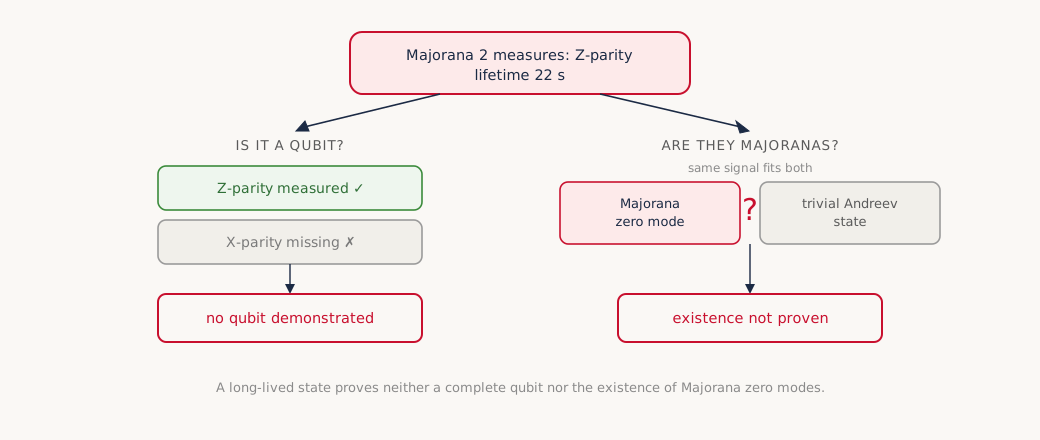
First, only the Z-parity was measured, not the X-parity. A working qubit needs both measurement directions. The paper itself concedes that this is „an important direction for future work". As a consequence, what is shown is a long-lived parity state, but not yet a working qubit.10
Second, the lifetime is not an existence proof. According to the paper the measured signatures are „consistent with Majorana zero modes", but „also potentially consistent with trivial Andreev bound states".10 It is exactly the ambiguity that already brought down the retracted paper in 2021. A long-lived state can be topologically protected. But it can also be an ordinary state that happens to last a long time.
Third, at the time of the announcement the work is not peer-reviewed. It was published on Microsoft’s site and on arXiv, not in a journal with peer review.10
The reactions followed accordingly. Henry Legg of the University of St Andrews: „Nothing in this preprint resolves the fundamental issues. Nothing in the presented data proves the existence of a topological qubit or Majoranas in these devices."10 Frolov called the work one that is „not based on a research track record that can be considered a solid foundation".10 There are also approving voices: Kartiek Agarwal of Argonne National Laboratory rated the new spectroscopy method „fantastic progress".10
The Open Question
The rift between research and announcement shows most sharply among the people who pushed the technology forward themselves. Lieven Vandersypen, chief scientist at QuTech, cleanly separates the two levels: he considers the materials research excellent, the claims attached to it „irresponsible". Microsoft’s press release, he says, „has little to do with the data publicly available so far". His verdict, quoted by DER SPIEGEL: „The proof of the existence of Majorana qubits has not yet been provided."2
Against this stand the company’s expectations. „By 2029 we will have a quantum machine that can solve economically relevant, meaningful problems", says Zulfi Alam, corporate vice president for Quantum at Microsoft.2 With that the company has halved its original timeline.1
Assessment
Two things are true at once. Microsoft is doing serious, difficult materials research here, and the switch to lead with its quadrupled energy gap is a real advance. At the same time the company is selling an interim result as a breakthrough, whose physical core assumption, the existence of Majorana qubits in these devices, remains unproven.
The pattern repeats: a result by press release, ahead of peer review, with an interpretation that goes beyond the data. In 2018 this pattern ended in a retraction. In 2025 in the referees’ finding that there was no evidence of Majorana zero modes. In 2026 the core question stands unchanged.
Should the proof one day succeed, the topological approach would indeed be a structural lead, because it builds stability into the physics instead of forcing it afterward through error correction. Until then the sentence from Delft holds. The proof has not yet been provided. A quantum chip that computes with a particle whose presence is unsettled is a bet, not a machine.
As of June 15, 2026. The primary source for the quotes by Lieven Vandersypen and Zulfi Alam is the reporting by DER SPIEGEL (translated from the German); technical details and further quotes from the sources linked below.
„Microsoft Unveils Majorana 2 Quantum Chip, Targets Commercial-Scale Quantum Computing by 2029", HPCwire, June 2026. https://www.hpcwire.com/off-the-wire/microsoft-unveils-majorana-2-quantum-chip-targets-commercial-scale-quantum-computing-by-2029/ ↩︎ ↩︎
„Majorana-2: Microsofts neuer Quantenchip rechnet mit Teilchen, deren Existenz unbewiesen ist", DER SPIEGEL (S+). Source of the quotes by Lieven Vandersypen (QuTech) and Zulfi Alam (Microsoft), translated from the German, and of the Delft/Microsoft project history. https://www.spiegel.de/thema/microsoft/ ↩︎ ↩︎ ↩︎ ↩︎
On the person and the 1937 theory („Teoria simmetrica dell’elettrone e del positrone") as well as the 1938 disappearance, see the biographical accounts of Ettore Majorana. https://en.wikipedia.org/wiki/Ettore_Majorana ↩︎
Introduction to Majorana zero modes, topological protection, and non-abelian braiding: „Majorana qubits for topological quantum computing", Physics Today 73, 6 (2020). https://pubs.aip.org/physicstoday/article/73/6/44/909657/Majorana-qubits-for-topological-quantum ↩︎ ↩︎ ↩︎
H. Zhang et al., „Quantized Majorana conductance", Nature (2018), since retracted. https://www.nature.com/articles/nature26142 ↩︎
„Retraction Note: Quantized Majorana conductance", Nature (2021); statement by TU Delft. https://www.nature.com/articles/s41586-021-03373-x ↩︎ ↩︎
„Setback for Majorana fermion as Microsoft team retracts research paper", phys.org, March 2021, on the role of Sergey Frolov and the Andreev states. https://phys.org/news/2021-03-setback-majorana-fermion-microsoft-team.html ↩︎
„Microsoft unveils Majorana 1, the world’s first quantum processor powered by topological qubits", Microsoft Azure Quantum Blog, February 19, 2025, on the topoconductor and materials stack. https://azure.microsoft.com/en-us/blog/quantum/2025/02/19/microsoft-unveils-majorana-1-the-worlds-first-quantum-processor-powered-by-topological-qubits/ ↩︎
„Physicists are mostly unconvinced by Microsoft’s new topological quantum chip", Science News, February 2025, with the referees’ finding „do not represent evidence for the presence of Majorana zero modes" and Frolov’s „just noise". https://www.sciencenews.org/article/microsoft-topological-quantum-majorana ↩︎ ↩︎
„Microsoft Majorana 2: 20-Second Qubits, Same Questions", PostQuantum.com, June 2026, with the technical analysis (Z- instead of X-parity, lead materials stack, 22 ± 1 s) and the quotes by Chetan Nayak, Henry Legg, Sergey Frolov, and Kartiek Agarwal. https://postquantum.com/industry-news/microsoft-majorana-2-analysis/ ↩︎ ↩︎ ↩︎ ↩︎ ↩︎ ↩︎ ↩︎ ↩︎ ↩︎
„Majorana 2, made more reliable with Microsoft Discovery agentic AI", Microsoft Source. https://news.microsoft.com/source/features/innovation/majorana-2-microsoft-discovery-agentic-ai ↩︎