MemPalace: How Milla Jovovich Cracked AI Memory
On April 5, 2026, Milla Jovovich and developer Ben Sigman released an open-source tool called MemPalace on GitHub. Within 48 hours: 23,000 stars, 3,000 forks, and a benchmark score of 96.6 percent on LongMemEval — the standard test for AI memory. Commercial competitors like Mem0 and Zep sit around 85 percent.
The truly interesting story isn’t that an actress codes. It’s the architecture behind it — and the response to the criticism that followed.
AI Amnesia
Anyone who has worked with Claude, ChatGPT, or Copilot for extended periods knows the pattern: A long, productive conversation. You explain the context, discuss alternatives, agree on an approach. The next day, you’re sitting across from a stranger. The AI doesn’t know you anymore, knows nothing about yesterday’s project, has forgotten the reasoning.
Jovovich hit this problem in late 2025, when she was using AI for a yet-unannounced video game. Months of character designs, design decisions, and creative groundwork — all gone with every new session.
Instead of diving into transformer architectures, she read about the ancient Greeks.
The Method of Loci
The Greek poet Simonides of Ceos survived the collapse of a banquet hall around 500 BC. The bodies were unidentifiable. Simonides could still name them — he remembered where each person had been sitting.
From this emerged the memory palace: a familiar building in one’s mind, in whose rooms you place information and retrieve it by walking through. The method works because the brain retains spatial structures better than abstract lists. Memory athletes use it to this day.
Jovovich’s premise: If this has worked for humans for two and a half millennia, it should work for an AI too.
Architecture: Raw Text Instead of Summaries
The key difference from existing memory tools lies in the storage strategy. Mem0, Zep, Letta, and Supermemory all work on the same principle: an AI decides what’s important and writes a summary. “User prefers Postgres” gets stored; the discussion of why Postgres was better than SQLite is lost.
MemPalace stores the complete conversation text — verbatim, unmodified, locally. The organization happens as a layer on top:
- Wings — Every project, every person, every topic gets its own area
- Halls — Within a wing, topics are organized into halls
- Rooms — The individual conversation units
- Tunnels — Automatic cross-connections between rooms that are thematically related but located in different wings
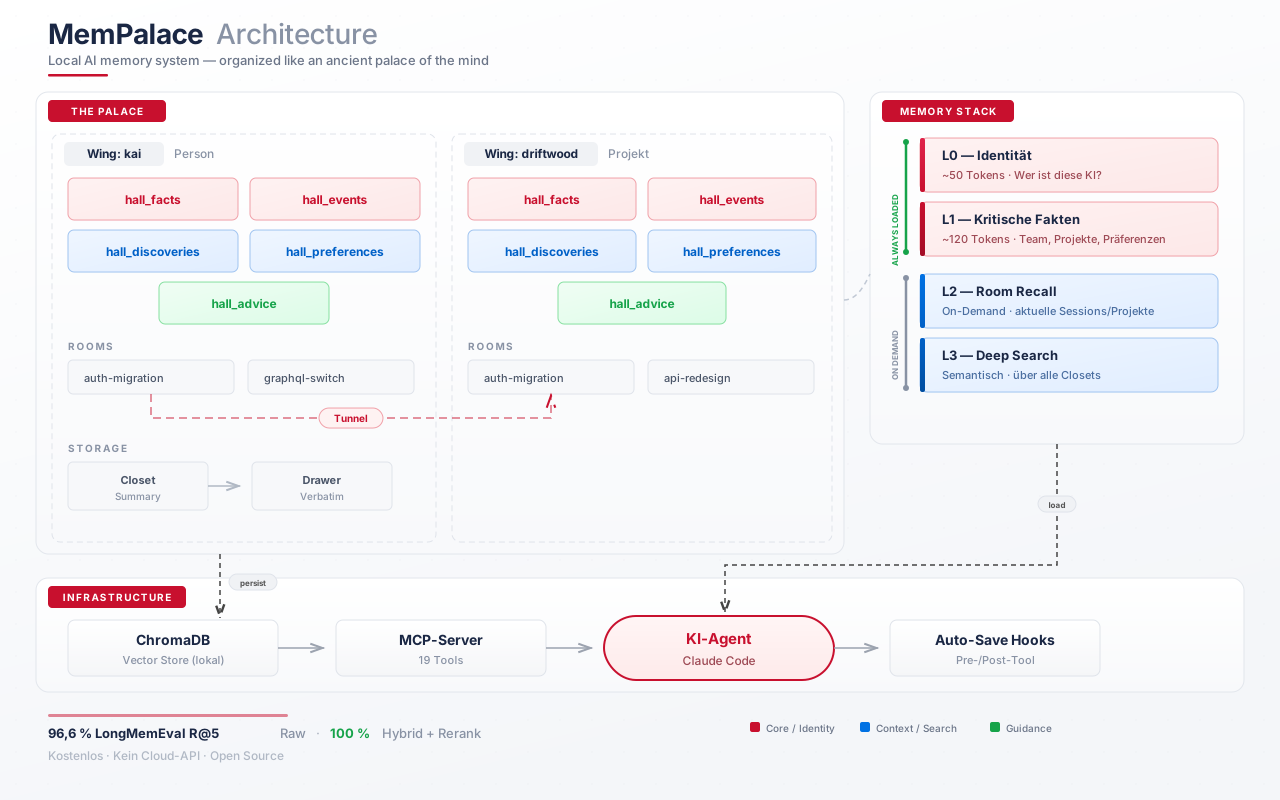
The consequence: If you ask “what did we decide about authentication?”, MemPalace delivers not just the decision, but the complete discussion in its original wording. The nuance survives.
Benchmark
On LongMemEval — the standard test where a system reads long conversations and must then answer precise questions about them — MemPalace achieves 96.6 percent. Without a single API call to an external AI service.
| System | LongMemEval | Cost/Month | Local |
|---|---|---|---|
| MemPalace | 96.6% | free | yes |
| Mem0 | ~85% | 19-249 EUR | no |
| Zep | ~85% | 19-99 EUR | no |
| Letta | ~80% | variable | partially |
An independent developer reproduced the result on their own Mac in under five minutes.
Criticism and Response
Within hours of the release, developers found problems: exaggerations in the documentation, a compression method that performed worse than claimed, incorrect token counts, and a feature description that the code didn’t deliver on. The original claim of 100 percent had to be corrected to 96.6 percent.
On April 7, Jovovich and Sigman published an open letter in the README — the most-read part of the project. They listed point by point what they had misrepresented, named the critics by name, thanked them, and closed with:
“We’re listening, we’re fixing, and we’d rather be right than impressive.”
In an industry where corrections are typically sold as “evolution,” that’s remarkable.
Three Properties
Local. All data stays on your own hard drive. For lawyers, doctors, and anyone working under GDPR or professional confidentiality, this isn’t optional — it’s the prerequisite for being allowed to use such tools at all.
Free. MIT license, one-command installation, no cloud service. The commercial competition charges 19-249 EUR/month for worse results.
Complete. Raw text instead of summaries. Six months later, you can ask “why did we decide against that vendor back then?” and get the reasoning, not a paraphrase.
Assessment
The next wave of AI improvements will probably not come from bigger models, but from the architecture around them. How you build memory for an AI, how you give it context, how you put tools in its hands — these are the questions that are becoming relevant right now. The models themselves are good enough. What’s missing is everything else.
Where MemPalace fits into the different types of AI memory, namely the episodic layer, which it stores as raw text instead of an AI summary, I later placed in an overview of LLM memory.
MemPalace shows that the first serious attack on an entire market segment doesn’t have to come from a startup with Series B funding. And that honest handling of mistakes is a better quality marker than any benchmark number.
A side note: In 1997, Jovovich played Leeloo in The Fifth Element — an artificial being with perfect memory, 28 years before real AIs still couldn’t pull that off. The pyramid in the MemPalace logo is a nod to that.
MemPalace is free, open source, and runs on your own machine. The repository is on GitHub, the origin story at https://mempalaceofficial.com
IMPORTANT:
The domain mempalace.tech is a brand-squatting site not affiliated with this project. It is known to run ad-redirects and potential malware. The official MemPalace distribution is only available via this GitHub repository and PyPI. Never install binaries or scripts from unofficial domains.
Translated with the help of Claude %%