n8n or SAP Integration — Not an Either-Or
Article 12 · Series: Getting Started with n8n
Across eleven articles this series built n8n up: from the first container through self-hosting, test data, rule-based and AI-driven classification, error handling, the SAP bridge, to queue mode. A series that explains and uses a tool also owes the sentence about where it does not belong. This article draws the line, against the two SAP-native tools that stand in the same space: Cloud Integration and the Edge Integration Cell. It is not a takedown. At the end of the right arguments n8n stays the right tool, just for a particular problem space.
Cloud Integration comes from the EAI tradition
The most common mistake is to see SAP Cloud Integration as the SAP variant of n8n. It is not. Cloud Integration, the core of the SAP Integration Suite, descends from SAP PI and PO and therefore from Enterprise Application Integration. Its building blocks are not webhook and Code node but message mapping, content modifier, splitter and router, and its vocabulary is that of SAP interfaces: IDoc, AS2, SFTP, OData, SOAP.
That is a different origin with different assumptions. Cloud Integration assumes a message has a defined format, that it is mapped, validated and checked against a schema, and that every step stays traceable. This world is built for the reliable exchange of structured business messages between systems, not for quickly wiring up cloud services. Put n8n right next to it and you are comparing an orchestration layer with integration middleware, and you misrepresent both.
Edge Integration Cell: control plane in the cloud, runtime in your own network
The Edge Integration Cell is an optional runtime of the Integration Suite. Its principle fits in one sentence: design, configuration and monitoring stay in the cloud, execution runs in your own data center. Technically it is a Kubernetes deployment in the customer network that runs the same integration flows you design in BTP, but the payload data does not leave your network.
Anyone who built along the last articles will recognize the building blocks. For production the Edge Integration Cell needs an external PostgreSQL and Redis; the internal variant is meant only for test and demo. That is exactly the split the queue mode from Article 11 makes too. The difference is not the infrastructure, it is what sits on top.
Two properties bound the Edge Integration Cell more cleanly than any marketing slide. First, it is not an autonomous on-premise system: it bridges a lost connection to the cloud only temporarily, currently for four hours, after which support ends. The control plane in the cloud is a precondition, not an accessory. Second, it does not yet cover the full adapter range of Cloud Integration, and the B2B adapters in particular are missing. So the Edge Integration Cell does not solve the B2B problem, it solves the data-residency problem.
n8n stays right for orchestration and AI integration
The line runs along the task, not along the vendor. n8n is the better choice when the requirement looks like this:
- Orchestration across several cloud services where no SAP B2B protocol is involved.
- Fast iteration, where a workflow stands in hours and may change daily.
- AI-agent integration, the way this series built it: LLM classification, tool calls, routing by model answer.
- Small to medium throughput, where queue mode with a few workers is enough.
- One developer team operating a tool, instead of an integration-platform department with its own operating model.
In that space n8n’s light weight is an advantage, not a shortcoming. The very layers Cloud Integration brings, and that the SAP standard expects, would be ballast here.
Cloud Integration wins at B2B, compliance and throughput
The other side is just as clear. Cloud Integration is superior as soon as one of these requirements appears:
- Compliance-driven audit obligations, where every message must be traceably and tamper-evidently logged.
- B2B protocols toward business partners: AS2, EDI, IDoc streams with guaranteed delivery.
- Defined SLAs toward partners, including business-level recovery when a message fails.
- Recovery mechanics that the SAP standard expects and that you want to inherit, not rebuild.
- Large to very large throughput, for which Cloud Integration’s persistence and scaling model is designed.
This is not a tool ranking. It is the description of two different problem spaces. Trying to rebuild a B2B EDI scenario with guaranteed delivery in n8n ends in a homegrown construct that duplicates what Cloud Integration already brings.
The Edge Integration Cell answers the data-residency question
The Edge Integration Cell is the answer to a requirement that n8n and Cloud Integration alone cannot meet at the same time: the data must not leave your network, but the configuration should still come centrally from the cloud. That gap is its place. Sensitive data stays in the external database in your own data center, only monitoring metadata travels to the cloud. For regulated industries and sovereignty requirements that is the decisive difference. For a setup without those constraints the Edge Integration Cell is extra operational effort without return, a Kubernetes cluster of your own to maintain.
Hybrids are the rule
In practice a single tool rarely stands alone. The support-ticket triage of this series can be laid out in three cuts, and the comparison shows the trade-offs better than any abstract table.
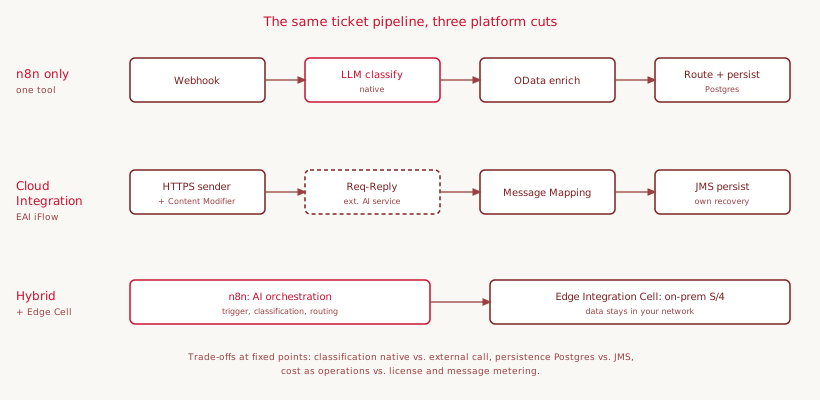
As a pure n8n workflow it is what this series built: webhook trigger, LLM classification over two backends, enrichment over OData, routing, all in one tool, set up in days. As a Cloud Integration iFlow the same pipeline would look different: an HTTPS sender adapter as the trigger, a content modifier for normalization, a request-reply against an external classification service, message mapping to the target format, persistence over the JMS adapter. The AI classification would be an external call, not a native node, because LLM integration is not Cloud Integration’s strength. As a hybrid with Edge Integration Cell the part that touches on-premise S/4 would run on the edge runtime in your own network, while the AI orchestration stays with n8n.
The trade-offs sit at fixed points: the trigger is HTTP everywhere, classification is native in n8n and an external call in Cloud Integration, persistence is Postgres in n8n and JMS with its own recovery in Cloud Integration, and the cost spreads differently, n8n pays with operational effort, Cloud Integration with license and message metering. A realistic target picture is therefore often not an either-or: n8n as orchestration for AI-driven workflows, Cloud Integration for the B2B layer to partners, Edge Integration Cell as the bridge to on-prem S/4. Three tools, three layers, one architecture.
A decision aid in five questions
For your own situation, five questions are enough to find the direction:
- Compliance: Must messages be logged in a tamper-evident, auditable way? If yes, that argues for Cloud Integration.
- B2B: Are AS2, EDI or IDoc streams to partners involved? If yes, this is Cloud Integration territory.
- Data residency: Must data stay in your own network while configuration stays central? If yes, the Edge Integration Cell is built for it.
- Throughput: Is queue mode with a few workers enough, or are very high, guaranteed throughputs required? Very high and guaranteed argues for Cloud Integration.
- Team: Does a developer team operate the tool, or is there an integration-platform department behind it? Without that department, n8n stays the realistic choice.
Three or more yeses toward compliance, B2B and throughput, and n8n is not the fitting tool. If it stays with orchestration, AI and manageable throughput, anything else is oversized.
Transition to Article 13
With that the problem space of n8n is staked out. Article 13 closes the series and draws a practical consequence from exactly this architecture: authentication over OAuth against a BTP destination, the real token flow behind the APIKey preview from Article 10. That is the point where n8n and the SAP world shake hands cleanly.