QuEra Libra: The Counter-Bet to Microsoft's Quantum Chip
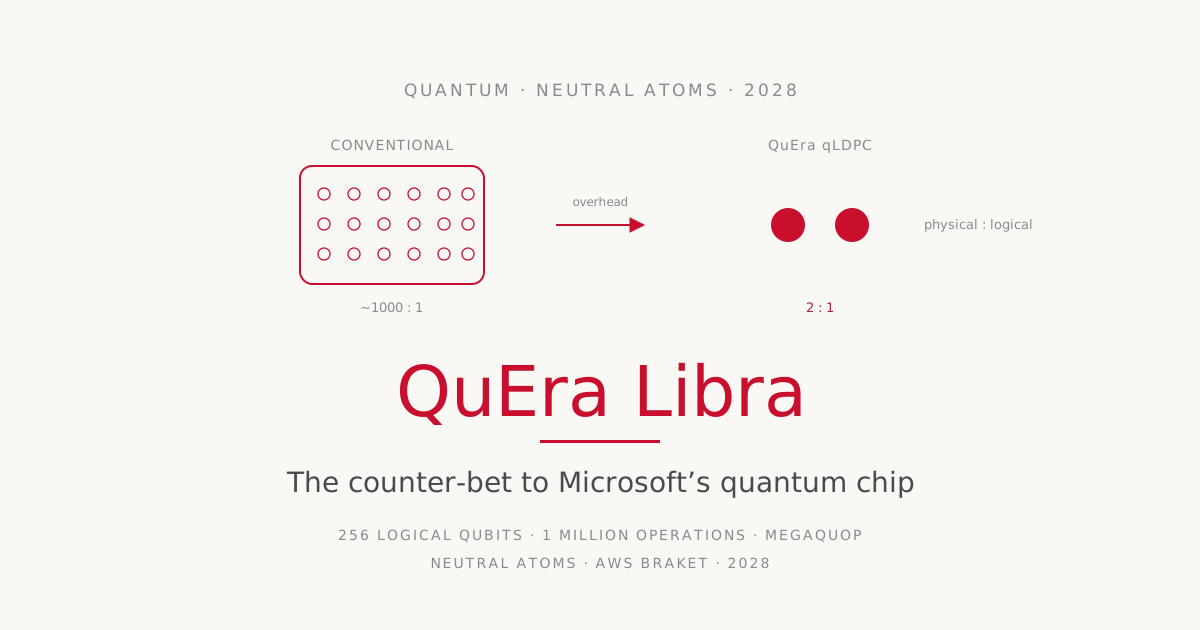
On June 15, 2026, the US startup QuEra announced that in 2028 it will ship a fault-tolerant quantum computer named Libra, with more than 256 logical qubits and a logical error rate of 10⁻⁶.12 The device is meant to manage about one million reliable logical operations and to be reachable through Amazon’s cloud service Braket.3
The announcement is interesting for a specific reason. While Microsoft, with its Majorana chip, bets on building stability into the physics through an exotic and so far unproven particle, QuEra goes the opposite way. Its qubits are ordinary atoms, and the stability does not come from the material but from error correction. The real advance lies in how little this correction costs QuEra.
Two Problems, One Lever
Two things have stood in the way of practical quantum computers so far. First, they have relatively few qubits. Second, those qubits are too error-prone. The second problem constrains the first in an unpleasant way: every operation can introduce an error, and beyond a certain number of operations the data becomes unusable.4
This is exactly where the bottleneck for any serious algorithm sits. A procedure that needs a million steps does not finish on a machine with an error rate of one in a thousand. Long before the result is in, the state has dissolved into noise. The number of executable operations, not the number of qubits, is therefore the figure that matters.
Logical and Physical Qubits
The way out of the error problem is error correction, and it works by separating two levels.
A physical qubit is the real device, the single atom, the single superconducting circuit. It is error-prone. A logical qubit is a compute unit encoded across many physical qubits. If an error occurs in one of the physical qubits, it can be detected and corrected without destroying the encoded state. The logical qubit is thus the robust, virtual qubit the algorithm actually computes with.5
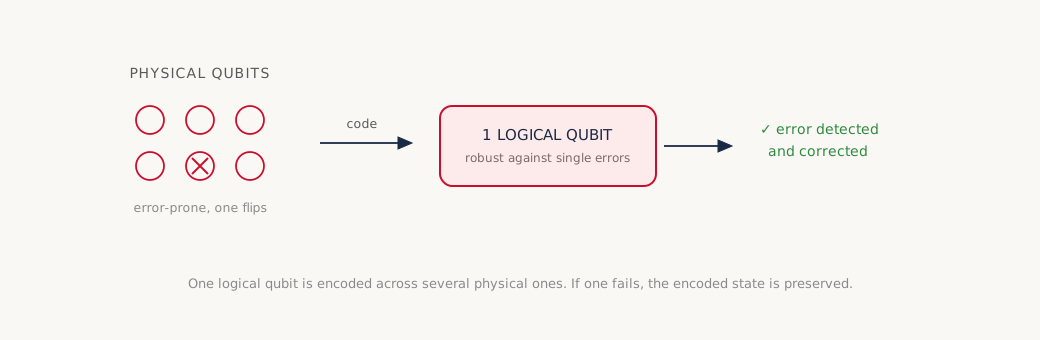
For this to work, the physical qubits’ error rate has to lie below a threshold, the fault-tolerance threshold. Below it, each additional correction layer lowers the logical error rate further. Above it, the correction creates more errors than it fixes.5 In 2024 Google showed for the first time that more physical qubits actually lower the logical error rate, the proof that one is working below the threshold.6
The price of this construction is overhead. In the common approaches a single logical qubit needs hundreds to thousands of physical qubits.5 That is exactly why people speak of „millions of physical qubits" when it comes to practically useful machines. And it is precisely this overhead that QuEra attacks.
Neutral Atoms in Optical Tweezers
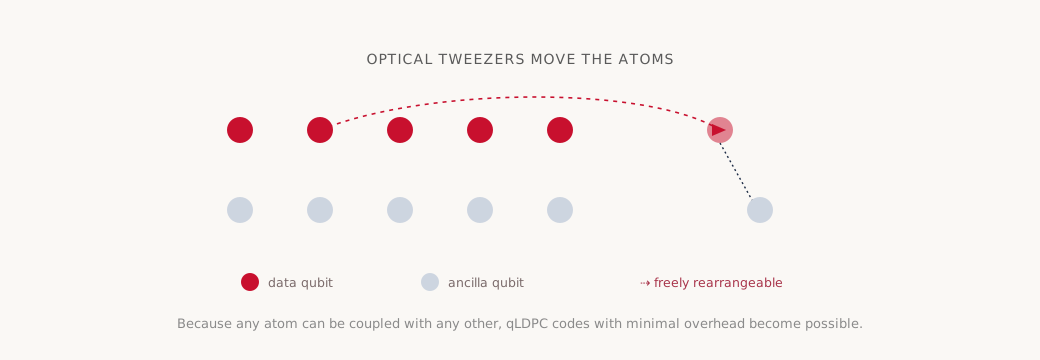
QuEra builds its qubits not from superconducting circuits but from neutral atoms, specifically from rubidium-87.7 The atoms are held by focused laser beams, so-called optical tweezers, and cooled to microkelvin near absolute zero. An elaborate dilution-refrigerator setup as in superconducting systems is not needed.7 The qubit sits in the atom’s electronic states and is switched with laser pulses.
The decisive advantage of this platform is not the cooling but the mobility. The optical tweezers can rearrange the atoms during operation without destroying quantum coherence.7 This makes it possible to couple practically any qubit with any other, an all-to-all connectivity that hard-wired architectures do not offer. And this free reconfigurability is the precondition for a particularly economical form of error correction.
The Real Breakthrough: Two Instead of a Thousand
In April 2026 a team from QuEra, Harvard, and MIT published work that drastically reduces the overhead.8 Instead of a surface-code-typical ratio of hundreds to thousands of physical qubits per logical qubit, the approach gets by with about two physical qubits per logical qubit.9
This is made possible by so-called qLDPC codes, quantum low-density parity-check codes, tailored specifically for movable atom arrays. They reach an encoding rate above 1/2, so each physical qubit carries on average more than half a logical qubit. The free reconfigurability of the atoms is the condition for this: a correction step reduces to a few shifts of the atoms instead of a rigid lattice of neighboring qubits.9
The simulated figures from the work are remarkable, and they are explicitly not peer-reviewed:
| Configuration | logical qubits | physical qubits | log. error rate per cycle |
|---|---|---|---|
| small | 580 | 1,152 | 2.9 × 10⁻¹¹ |
| large | 1,156 | 2,304 | 1.3 × 10⁻¹³ |
An error rate of 10⁻¹³ means about one error per ten trillion operations.8 That is the regime in which even long algorithms run safely. The caveat remains: these values come from a simulation under realistic noise assumptions, not from a running device.
Megaquop, Not Yet Teraquop
By QuEra’s own classification, Libra is a megaquop system, designed for the order of one million reliable logical operations.1 That is a concrete benchmark, and it is worth placing it.
The field counts in powers of ten of operations. The term megaquop comes from John Preskill and means a machine that manages around 10⁶ reliable operations, enough for first scientifically interesting computations in chemistry, materials simulation, and optimization.43 For what the headlines usually mean, such as breaking today’s encryption, you need a teraquop, that is 10¹² operations, a million times more. The simulated 10⁻¹³ from the April work points in that direction; Libra itself does not reach it yet.
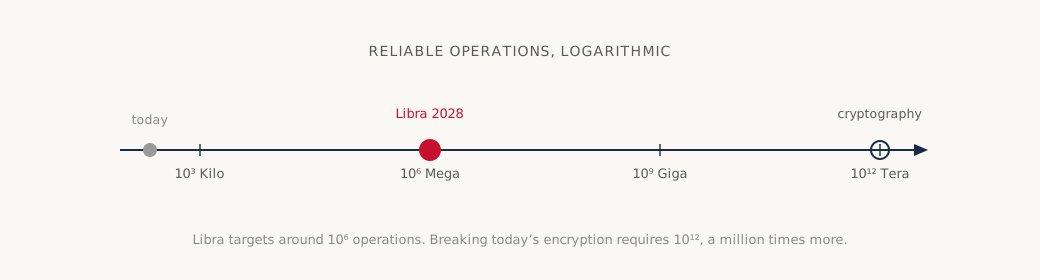
Megaquop is therefore not a marketing label but a precise placement: well beyond today’s noisy machines, but still clearly short of the applications that make cryptographers nervous.
A Roadmap, Not a Computer
For all its substance, Libra remains an announcement for 2028. What QuEra can show is not a finished device but a foundation of prior work. Unlike at some competitors, this foundation is largely peer-reviewed: the company points to eight publications in „Nature" and „Physical Review Letters" as well as to the predecessor hardware Aquila with 256 physical qubits, running on AWS Braket since 2022.1
The tones of those involved nonetheless remain those of a roadmap. QuEra CEO Andy Ory says: „Fault-tolerant quantum computing is moving from a scientific milestone to an engineering and deployment roadmap."1 His chief commercial officer Yuval Boger ties this to a warning to prospective customers: „Waiting until 2028 to build a quantum strategy is a competitive risk."1 From the AWS side, Eric Kessler, General Manager of Amazon Braket, frames the step more cautiously: „QuEra’s technology has demonstrated a clear path to that future."1 A clear path is not yet a distance covered.
Two Bets on the Same Goal
Set the announcement next to Microsoft’s Majorana 2 chip and a fundamental contrast becomes visible. Both want the same thing, a quantum computer that stays stable long enough to be useful. But they start at opposite ends.
Microsoft tries to put the stability into the physics itself, via topologically protected Majorana qubits, and faces the problem that the existence of these qubits is unproven. QuEra takes error-prone but well-understood atoms and forces the stability through error correction, whose overhead the company has drastically cut. One bet stands or falls with an open physics question. The other stands or falls with an engineering question, whether the simulated efficiency holds up in hardware.
Both are open, but not in the same sense. An engineering question has a known solution path that merely has to be walked. An open question about the existence of a particle does not. In that sense QuEra’s roadmap is also a promise, but one built on what has already been measured, not on a hope. Whether 2028 holds will be shown by the hardware, not the press release.
As of June 16, 2026. The basis is QuEra’s announcement of June 15, 2026, supplemented by the underlying publications, John Preskill’s megaquop concept, and the AWS Quantum blog.
„QuEra Announces 2028 Fault-Tolerant Quantum Computer and Expanded Multi-Year Strategic Collaboration with AWS", QuEra/PR Newswire, June 15, 2026, and the write-up at The Quantum Insider with the quotes by Andy Ory, Yuval Boger, and Eric Kessler. https://thequantuminsider.com/2026/06/15/quera-announces-2028-fault-tolerant-quantum-computer-and-expanded-aws-collaboration/ ↩︎ ↩︎ ↩︎ ↩︎ ↩︎ ↩︎
„QuEra Outlines 2028 Roadmap for 256-Logical-Qubit ‚Libra’ System and Expanded AWS Cloud Partnership", Quantum Computing Report, June 2026, on the target values (256 logical qubits, logical error rate 10⁻⁶, megaquop class). https://quantumcomputingreport.com/quera-outlines-2028-roadmap-for-256-logical-qubit-libra-system-and-expanded-aws-cloud-partnership/ ↩︎
„AWS Deepens Strategic Collaboration with QuEra to Bring Fault-Tolerant Quantum Computing to Amazon Braket", AWS Quantum Technologies Blog, June 2026. https://aws.amazon.com/blogs/quantum-computing/aws-deepens-strategic-collaboration-with-quera-to-bring-fault-tolerant-quantum-computing-to-amazon-braket/ ↩︎ ↩︎
John Preskill, „Beyond NISQ: The Megaquop Machine", arXiv:2502.17368 (2025), ACM Transactions on Quantum Computing. Origin of the megaquop term and basis for the fact that the logical error rate limits the number of executable operations. https://arxiv.org/abs/2502.17368 ↩︎ ↩︎
„What Is Quantum Error Correction & How Does It Work", The Quantum Insider, March 2026, on logical and physical qubits, threshold, and overhead. https://thequantuminsider.com/2026/03/16/understanding-quantum-error-correction-physical-logical-qubits/ ↩︎ ↩︎ ↩︎
„Quantum error correction below the surface code threshold", Nature (2024), on the first demonstration of below-threshold error correction. https://www.nature.com/articles/s41586-024-08449-y ↩︎
„Aquila: QuEra’s 256-qubit neutral-atom quantum computer", arXiv:2306.11727 (2023), on the platform of rubidium-87, optical tweezers, and movable atoms. https://arxiv.org/abs/2306.11727 ↩︎ ↩︎ ↩︎
„Towards Ultra-High-Rate Quantum Error Correction with Reconfigurable Atom Arrays", arXiv:2604.16209 (April 2026), not peer-reviewed. Source of the simulated configurations (580/1,152 and 1,156/2,304) and error rates. https://arxiv.org/abs/2604.16209 ↩︎ ↩︎
„Quantum Error Correction at Record Efficiency: Why Neutral Atoms Are Leading the Way", QuEra Blog, 2026, on the 2:1 ratio and the qLDPC codes. https://www.quera.com/blog-posts/quantum-error-correction-at-record-efficiency-why-neutral-atoms-are-leading-the-way ↩︎ ↩︎