Three Days at the Frontier: The Trump Regime Pulls Fable 5 and Mythos 5
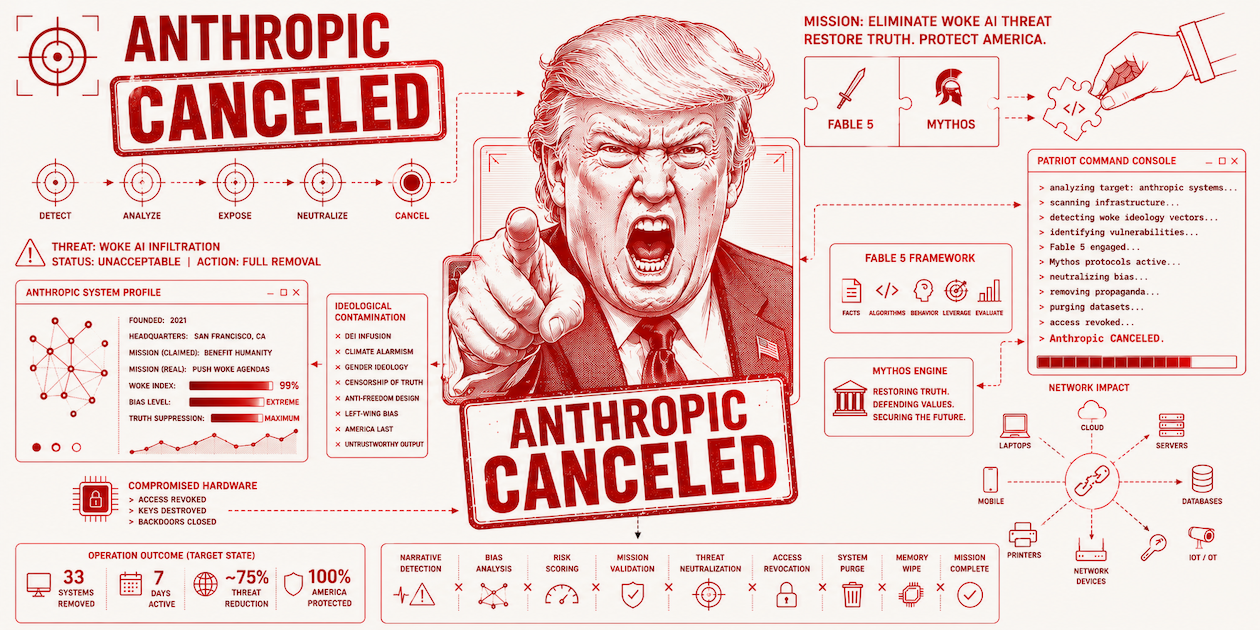
On June 9, Anthropic rolled out Fable 5 to the public. Three days later, on Friday at 5:21 PM Eastern Time, a directive from the Trump regime landed on the table that forced the company to disable both Fable 5 and Mythos 5 for every customer. It is, as far as anyone can tell, the first time a leading AI company has taken an already deployed model offline on a federal order.
The story is still moving, but the facts are now solid: Anthropic published a detailed statement, several major outlets from Bloomberg to Fortune to NBC reported on it, and Axios supplied the missing piece of the backstory. Here is what is known.
What the directive demands
The order came from the US Commerce Department, drafted with the involvement of the Bureau of Industry and Security, signed by Commerce Secretary Howard Lutnick and addressed to Anthropic CEO Dario Amodei. The legal lever is export control, invoked on national security grounds.
The decisive point is scope. The directive bars Anthropic from giving access to Fable 5 and Mythos 5 to any foreign national. That means not only people outside the US, but also any non-citizen inside the US, expressly including Anthropic’s own non-citizen employees.
At that breadth there was no technical middle ground. A selective block for non-citizens only is not cleanly enforceable on a globally deployed model, so Anthropic disabled both models entirely, for everyone. The remaining models stay available.
The accusation: a jailbreak
As justification, the government says it became aware of a method to bypass, or jailbreak, Fable 5. The directive provided no concrete details about the national security concern. Anthropic was allowed to view a demonstration of the technique and describes it soberly: at its core, it involves asking the model to read a specific codebase and fix software flaws in it.
According to Anthropic, that demonstration surfaced only a small number of previously known, minor vulnerabilities, ones that other commercial models can find anyway. In the language of the statement: a narrow, non-universal jailbreak. Not a master key that unlocks the whole model, but at best a thin gap.
This is exactly where the disagreement sits. Anthropic says it had equipped Fable 5 with unusually hard safeguards:
- Thousands of hours of red-teaming by the US government, the UK AI Safety Institute, and third parties
- A new 30-day data retention policy the company calls a real cost factor
- A defense-in-depth strategy meant to make jailbreaks either narrow or expensive
- Continuous monitoring to detect and shut down successful attacks
The logic behind it: there is no perfectly jailbreak-resistant model, so you make a comprehensive break extremely expensive and any successful single case quick to find. Against that backdrop, Anthropic regards the discovered gap as precisely what its own safeguards account for, not as grounds for a recall.
The core sentence of the statement:
We disagree that the finding of a narrow potential jailbreak should be cause for recalling a commercial model deployed to hundreds of millions of people.
Anthropic also warns of the precedent. Applied industry-wide, the same standard would essentially halt every new model rollout from every frontier provider.
The backstory, per Axios
The missing context comes from Axios. According to it, an unnamed company had claimed to have jailbroken Mythos. And the administration had already tried, before launch, to get Anthropic to delay the release of Mythos and Fable, without success. The export-control directive came after that path had failed.
That shifts the frame. What looks like a purely technical security question turns out to be a process with a run-up, in which a previously rejected request was pushed through after all, through a different legal instrument.
The irony in the timing
The proximity to Anthropic’s own stated position is striking. Only days earlier the company had argued that the government should have the right to block risky AI models. In the current statement Anthropic holds to that, but ties the right to conditions: transparent, fair, clear, and grounded technical facts. Those are exactly the conditions the company does not see met in this case.
It is the uncomfortable version of landing on your own principle. Whoever grants the government a kill switch does not get to choose when it is pressed.
Reactions
The takes from the surrounding field were sharp. Dean Ball, an AI policy expert and former Trump administration official, said:
I can’t tell if this is lawfare against Anthropic in particular or extreme national-security hawkery. Regardless, it is simply cartoonish.
Security researcher Peter Girnus aimed at Anthropic’s own messaging:
If you describe your product as a munition in every press release, eventually a government takes you at your word.
AI critic Gary Marcus, in turn, warned of the side effects: the directive would likely push Chinese-born AI researchers back to China and damage investor confidence in American AI companies.
One detail underlines the contradiction in the government’s stance. While Anthropic is effectively treated as a national security supply chain threat in this episode, the NSA at the same time runs Mythos on classified networks. The same model is simultaneously too dangerous for foreigners and trustworthy enough for intelligence infrastructure.
What this means for users in practice
In practical terms the situation is clear. Running Fable 5 sessions end with an error. New sessions fall back to the respective default model, usually Opus 4.8. API requests to Fable 5 also return an error; integrations have to be switched to other models.
Anyone who wired scheduled tasks or automations to Fable 5 specifically should switch them over. The pragmatic recommendation, anyway, is to run automations on the default model rather than a pinned version. That way a task automatically lands on the current top model instead of running into a wall when one is shut off.
Assessment
The episode is notable for two reasons. First the mechanism: export control that, by way of the foreign national detour, effectively topples a worldwide rollout entirely, even though the letter of it only addresses non-citizens. Second the precedent. When an already shipped model has to go offline over a gap classified as minor, that moves the line of what counts as available from the technical domain into the regulatory one.
How long the state of affairs lasts is open. It may turn out to be a misunderstanding and access returns within days. It may also be that the requirements for capable models tighten going forward, up to identity verification for use. The only thing solid right now is what stands above. The rest remains to be seen.
Update, June 14: The Investor, the Competitor, and the AI Czar
A day later the story gains a second layer, and it reads like a business thriller. According to TechCrunch, Amazon CEO Andy Jassy had already told Treasury Secretary Scott Bessent and other government officials, before the directive, that Amazon researchers had used Fable 5 to obtain information that could be used in cyberattacks.1 Asked about it, an Amazon spokesperson said it is „not uncommon for governments to seek our counsel on potential security risks", but that the company does not share the details of those conversations.
The catch is Amazon’s dual role. Amazon is Anthropic’s largest backer, most recently with 5 billion US dollars in April 2026 and a 100 billion cloud spending commitment, and at the same time a direct competitor with its own Nova models and the Bedrock platform on AWS.1 An investor that is also a competitor hands the government the argument that takes its own portfolio company’s model offline. The Next Web describes exactly this as the creation of a „new weapon" in AI competition.2
Next to it stands a second account, and it comes from the very top. David Sacks, serving in the White House as AI and crypto czar and co-chairing the President’s Council of Advisors on Science and Technology, describes the trigger differently: „a highly credible trusted partner of both Anthropic and the USG came forward with a jailbreak." And further: „The Admin asked Dario to fix the jailbreak or de-deploy the model. Dario refused."3 Two versions, one outcome.
Sacks is no neutral party in this matter. His antipathy toward Anthropic is documented and older than the current case. He accused the company of a „sophisticated regulatory capture strategy based on fear-mongering", called it „woke", and alleged that Anthropic times alarming safety studies to model releases to generate headlines.4 In October 2025, Dario Amodei publicly disputed these claims. Part of the background was Anthropic’s opposition to a ten-year moratorium on state-level AI laws, that is, opposition to exactly the deregulation Sacks pushes.
Then there is the financial side. Sacks’s venture firm Craft Ventures, by its own account managing around 3.3 billion US dollars, is invested in xAI, Elon Musk’s AI startup and a direct Anthropic competitor, as well as in SpaceX. Sacks is regarded as a close Musk ally.5 A government adviser who helps shape AI policy while holding a stake in a direct competitor of the company that was shut down: ethics observers have seen a conflict of interest there since Sacks took office.
So that the thriller does not tip into a conspiracy tale, the counter-reading belongs here too. Semafor links the move to concerns about Chinese access to Mythos, a national security question that is not purely competitive.6 And Jassy’s tip may be substantively justified. An investor who discovers an abusable capability in a portfolio company has legitimate reasons to report it.
What remains is a web of money, politics, and competition. An investor that is also a competitor reports the problem. A government adviser with a long-standing antipathy and a stake in a rival sits at the lever. An already shipped model goes offline. Whether this was about a genuine security flaw or about displacement by state means cannot be cleanly separated from the outside. The only thing provable is that the line between market competition and regulation became permeable in this case.
As of June 14, 2026. The primary source is Anthropic’s official statement, supplemented by reporting from Bloomberg, Fortune, NBC News, Axios, TechCrunch, The Next Web, CNBC, and Semafor.
Maxwell Zeff, „Amazon CEO reportedly raised Anthropic model concerns before government crackdown", TechCrunch, 13 June 2026. https://techcrunch.com/2026/06/13/amazon-ceo-reportedly-raised-anthropic-model-concerns-before-government-crackdown/ ↩︎ ↩︎
„Amazon’s CEO reportedly triggered the government crackdown that shut down Anthropic’s most powerful AI", The Next Web. https://thenextweb.com/news/amazon-jassy-triggered-anthropic-fable-mythos-crackdown ↩︎
David Sacks on X, quoted via TechCrunch and The Next Web (as of 13 June 2026). ↩︎
„Anthropic CEO disputes Trump AI czar David Sacks’ claims that company is ‘woke’", CNBC, 21 October 2025. https://www.cnbc.com/2025/10/21/anthropic-ceo-trump-sacks-woke.html ↩︎
„Who is David Sacks, the Bay Area venture capitalist tagged by Donald Trump to lead on AI, cryptocurrency?", Seattle Times, and „Trump tech adviser David Sacks under fire over vast AI investments", NPR, 12 December 2025, on Craft Ventures, the xAI stake, and the conflicts of interest. https://www.npr.org/2025/12/12/nx-s1-5631823/david-sacks-ai-advisor-investment-conflicts ↩︎
„White House move to limit Anthropic linked to concerns about Chinese access to Mythos", Semafor, 13 June 2026. https://www.semafor.com/article/06/13/2026/white-house-move-to-limit-anthropic-linked-to-concerns-about-chinese-access-to-mythos ↩︎